
Answering your search for a reliable pop up camper water pump, this guide highlights five top 12V options that fit on-demand water needs in campers, tiny homes, and off‑grid setups. These pumps are chosen for quiet operation, self-priming capability, and compatibility with solar or battery power. Ideal buyers include full‑timers who need steady freshwater supply, weekend campers seeking easy installation, and RV enthusiasts who want dependable, low‑maintenance pumps. A quick summary table compares key specs to help you decide at a glance.
Product Snapshot
| Product | ||||
|---|---|---|---|---|
| DC HOUSE 12V RV Water Diaphragm Pump | 3.5 | 45 | 9.8 | Quiet RV replacement, larger campers |
| ECO-WORTHY RV Fresh Water Pump | 3.5 | 45 | 9.8 | On‑demand, adjustable range |
| WASSERMANN RV Pump | 4.0 | 45 | Unknown | Complete kit, versatile power |
| LynsaTac 12V RV Water Pump | 1.0 | 35 | Unknown | Compact, quiet for smaller setups |
| SEAFLO 21‑Series Pump | 1.2 | 35 | Up to 4 ft | NSF/UL compliant, long warranty |
DC HOUSE 12V RV Water Diaphragm Pump
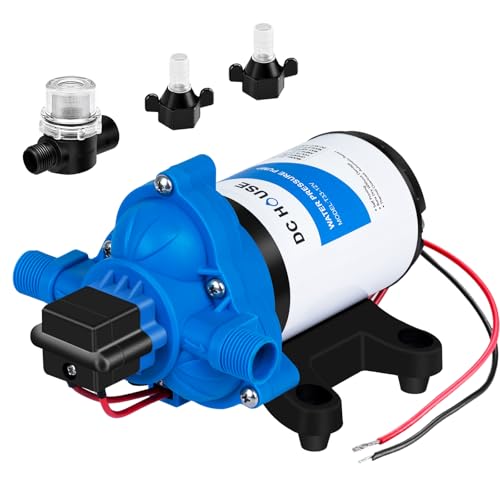
Best for: Those needing a quiet, easy install in larger campers and motorhomes. This model is designed as a quiet replacement pump for mainstream American RVs, with 12V DC power for solar compatibility and vehicle integration. It provides on‑demand water with a 45 PSI cap and a 3.5 GPM flow, making it suitable for simultaneous faucet use in multiple lines.
Why selected: It combines quiet operation with reliable self‑priming and a built‑in thermal protector to guard the motor. Its 9.8 ft self‑prime capability helps with rear or elevated water tanks, and its adjustable pressure switch allows tailoring performance to your water needs.
Caution: The unit relies on correct wiring and pressure switch adjustment. Misadjustment can lead to short cycling or reduced flow in high‑demand scenarios.
ECO-WORTHY RV Fresh Water Pump

Best for: Campers seeking a budget‑friendly, reliable on‑demand pump with an adjustable 35–80 PSI range. This pump is well‑suited to RVs, yachts, and campers that require consistent flow without high amperage draw.
Why selected: It features a 3.5 GPM flow at 45 PSI and a self‑priming design up to 9.8 ft. A built‑in thermal overload protector helps prevent motor damage, and the adjustable pressure switch supports customizing pressure to different fixtures.
Caution: It can be sensitive to dry running. Ensure water in the system before startup to avoid unnecessary wear.
WASSERMANN RV Pump

Best for: Campers who want a complete kit with mounting hardware and fittings for a plug‑and‑play installation. This 12V pump delivers up to 4 GPM at 45 PSI, offering robust performance for a mid‑size RV or boat.
Why selected: The complete kit includes hose adapters, a debris filter, and a user manual, which simplifies setup in new installations or replacements. It is designed for steady, reliable pressure suitable for multiple outlets.
Caution: The kit’s power versatility is a strength, but ensure your electrical system can support a 12V motor without excessive draw or wiring losses.”””
LynsaTac 12V RV Water Pump

Best for: Smaller campers or tight spaces where compact size and quiet operation matter. This unit provides 1.0 GPM at 35 PSI, with a 12V setup and a 360° rotatable faucet for flexible installation.
Why selected: Built‑in check valve helps prevent backflow, and the faucet base includes a waterproof start switch for easy operation. It’s ideal where space is at a premium and modest water demand is acceptable.
Caution: Lower flow means it may not satisfy simultaneous multiple‑fixture use in larger rigs — plan for single‑stream use when space is limited.
Zebra RV Water Pump (Combo)

Best for: Users who want a city water and tank water solution in one compact unit. The Zebra combo pump and faucet are designed for marine, RV, and van use with a simple control handle for standard tank or city water modes.
Why selected: It provides a straightforward manual method to switch between tank and city water, which can be practical for lightly used pop‑ups or day trips. The 45 PSI typical focus offers adequate pressure for most small fixtures.
Caution: The two‑position handle method requires familiarity to avoid accidental misoperation when shifting between supply sources.
DICMIC 3.0 GPM 12V 55 PSI Revolution Pump

Best for: Those needing a quiet, durable replacement with higher pressure for showers or sprayers in a camper. The Revolution design includes a one‑piece diaphragm for long life and built‑in check valve.
Why selected: It emphasizes quiet operation, thermal protection, and dry‑run capability, which are valuable in off‑grid or remote installations where maintenance should be minimal.
Caution: Verify compatibility with your vehicle’s electrical system and ensure proper wiring to avoid thermal shutdown during high demand.
bayite 12V Fresh Water Pump

Best for: Campers needing a balanced motor design with low current draw and high reliability for moderate to long trips. This pump uses 3/8‑inch hose ports and offers an 80 PSI cut‑off with a 4 L/min nominal flow.
Why selected: The design prioritizes longevity via precision bearings and a built‑in thermal breaker. It is not submersible and warns against use in wet environments, making it a fit for dry installs with protected mounting.
Caution: Not intended for submersion or direct exposure to standing water; ensure proper enclosure to avoid moisture exposure and motor damage.
Buying Guide: Key Considerations for Pop Up Camper Water Pumps
- Flow rate versus demand: Smaller campers may be fine with 1.0–1.5 GPM, while larger pop ups benefit from 3.5 GPM or more for simultaneous fixtures.
- Pressure range: A 30–45 PSI range is common; adjustable switches offer customization for different fixtures such as showers and sinks.
- Self‑priming capability: Look for units that self‑prime up to at least 6–10 ft to accommodate elevated tanks or faucets far from the pump.
- Power source and draw: Most RV pumps run on 12V DC. Confirm battery capacity and solar compatibility for off‑grid setups.
- Protection features: Thermal overload protection and dry‑run tolerance extend motor life in rough camping conditions.
- Installation kit: Some pumps include hoses, adapters, or filters—these reduce setup time and compatibility concerns.
- Material and size: Consider compact pumps for pop‑ups with limited space; check inlet/outlet threading and hose diameter compatibility.
- Water source and safety: For potable water, ensure the pump and fittings meet applicable standards and are suitable for drinking water systems.
Frequently Asked Questions
- What is the typical flow I should expect for a pop‑up camper? Answer: Most pop‑ups use 1.0–3.5 GPM, depending on the number of fixtures and usage patterns.
- Do I need a pressure tank with these pumps? Answer: A pressure switch often controls the system; a dedicated tank can help stabilize pressure and reduce cycling.
- Can I run these pumps off a solar setup? Answer: Yes, many 12V pumps are compatible with solar panels and battery banks when wired correctly.
- Is self‑priming necessary for a camper pump? Answer: Self‑priming simplifies installation, especially when the pump sits above the water source or tank.
- What maintenance is required? Answer: Regularly inspect hoses for leaks, clean debris filters, and ensure electrical connections are tight and dry.
- Are these pumps safe for potable water systems? Answer: Some units are built with potable‑water standards; verify NSF/UL listings or manufacturer statements for each model.